Search this blog

Thursday, 14 July 2011

Artwork of the day

Bastille Day at Lorient 1892, Henry Moret, 1892, oil on canvas, Galerie L'Ergastere, Paris, France

Bastille Day at Lorient, 1892, Moret, Henry (1856-1913)   Picture from http://www.bridgemanart.com

Tuesday, 12 July 2011

Women and Impressionism Part 1


Women artists
Impressionism has been widely accepted as the style that first introduced modernism in art. Modernism in both the techniques used by artists and the subjects represented – mainly the emerging industrial city life. Space –as a reality and as a subject in art- is thus a very important part of Impressionism.
Impressionism also saw the rise of a number of women artists like Berthe Morisot, Mary Cassatt, Eva Gonzalès and Marie Bracquemond.
What spaces are represented in the art of women impressionists and is there a difference with the spaces depicted by their male colleagues? This question has been central especially to feminist critique. According to Griselda Pollock the spaces represented by women painters are those traditionally related to the bourgeois women of the period: areas or areas related with acceptable female bourgeois leisure, involving child care (picture 1), pass time and intimate garden scenes (picture 2).


 Picture 1. Mary Cassatt, The Bath, 1892, oil on canvas, The Art Institute of Chicago

 Berthe MORISOT «La Chasse aux papillons»
  Picture 2. Berthe Morisot, La Chasse aux papillons, 1874, oil on canvas, 46 x 56 cm, Musée d'Orsay, Paris

The public sphere was not a space where a woman of the bourgeois class could be seen on her own. The honourable woman was secluded in the domestic sphere and thus the places she depicted as an artist were limited to what was expected from her.
These boundaries of domestic space can be seen in the spatial order of the paintings, which constitute the second way in which Pollock views space and femininity. For Pollock, the space in paintings by women impressionists displays the use of facture, demarcation and compression in order to show the boundaries inside the picture itself but at the same time the boundaries of the city, the boundaries between the domestic and the public. If we came back to Morisot’s and Cassatt’s paintings examined earlier we can see that we, as viewers, enter the world of the bourgeois woman, experience it. But at the same time we are denied any intimacy as those represented avoid any eye contact. In the end, we are invited to a world where women can be observed but they themselves cannot observe.


References
Pollock, G. 2003, Vision and Difference, London & New York: Routledge Classics

Wednesday, 6 July 2011

Artwork of the day

Proteus, Cy Twombly, 1984, Synthetic polymer, coloured pencil and graphite on paper 


In memory of Cy Twombly who died yesterday, 5/7/2011.
For an obituary look at: http://www.guardian.co.uk/artanddesign/2011/jul/06/cy-twombly-obituary
Picture from Gallery 1 in http://www.cytwombly.info/

Wednesday, 29 June 2011

Artwork of the day

Self Portrait, Peter Paul Rubens, 1638-1640, oil on canvas, Kunsthistoriches Museum, Vienna 


434 years since Rubens' birth. He was born on 28 June 1577 and became one of the major exponents of Baroque.

Tuesday, 28 June 2011

Artwork of the day

Rue Transnonain, Honoré Daumier, 1834, lithograph


It should be obvious by now that I'm a big fan of 19th century French Realism. Daumier is particularly dear to me as his art is meant to be both humorous and real, a critique to the social, political and economic situation of 19th century France and serving eventually as a visual history of Daumier's times. In this case it is a tragic event that Daumier depicts and immortalizes in his art. Rue Transonain was created in 1834 and shows the aftermath of a real event in this Parisian route. In April 1834 during a social unrest, governmental troops entered a building and killed all its inhabitants. The lithograph depicts one single room and lives to the imagination of the viewer the scenery in the rest of the building. Death is present everywhere in the scene. The man in the foreground that wears his night robe was probably dragged out of his bed and killed. A baby lies beneath him, an old man right next to him. With this work Daumier criticizes the violence of the army, but also the ill decisions of a monarchy that had little concern for the poor citizens of the country.

Wednesday, 22 June 2011

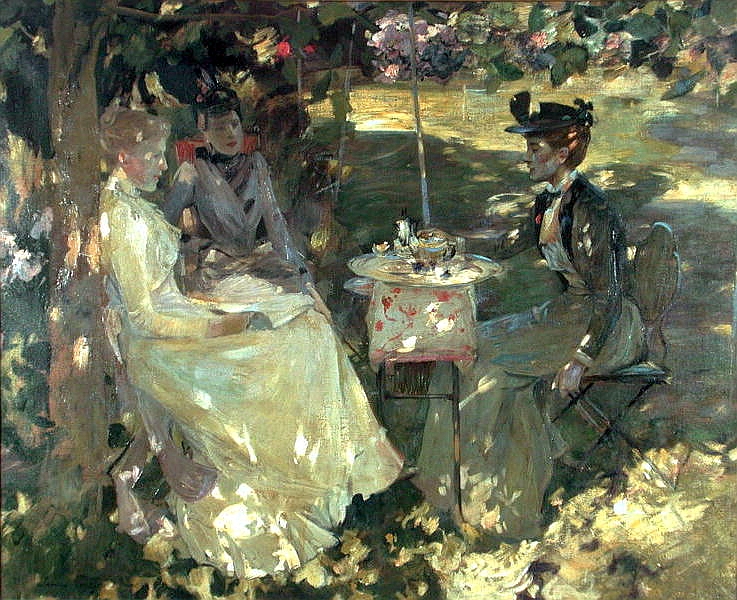
June painting

Midsummer, James Guthrie, 1892,  oil on canvas, Royal Scottish Academy, Edinburg, Scotland


 File:James Guthrie - Midsummer 1892.jpg

Artwork of the day

The “Ladies in Blue” Fresco, c. 1650-1550 BC, Archaeological Museum, Herakleion, Crete


The “Ladies in Blue” fresco from Neopalatial Knossos illustrates a group of three women of high esteem in rich costumes who aim at the retention of their power and at the improvement of their social status by adopting new symbols of differentiation such as the elaborate hairstyle. The fresco dates to 1650-1550 BC and it has been greatly restored. The white-skinned ladies with the graceful posture of their arms, the exposed breasts and the elaborate hair and jewellery are depicted while conversating with each other perhaps during a court festival or another important social or religious ceremony. They might be goddesses or just court ladies who want to show how important they are.
The elaborate hairdressings of the “Ladies in Blue” seem to have characterized the rich ladies of the New Palace Period who adopted them in important ceremonial events. According to Minoan iconography the shift from the hat to the long hair or elaborate hairdressings that predominate in the New Palace Period is said to have reflected the choice of high status women who stressed the head significance because they wanted to differentiate themselves from the total of women as soon as the latter started using the hat as part of their attire. In other words this stylistic change served to promote the ideological strategies of the dominant groups of women that emerged in the Neopalatial Period and wished to differentiate themselves from the rest of women by keeping a distance from them and simultaneously by emphasizing the stylistic details of their social group.

Today's artwork is a generous contribution of Eleftheria Pavli, BA, MA